
Introduction
In Hinduism, Gotra refers to the lineage or clan assigned to an individual at birth. It is a system that traces ancestry, usually patrilineally, and connects families to ancient sages or revered ancestors. Gotra is not merely a genealogical marker but a cultural identity that plays a vital role in social organization, marriage customs, and religious practices. Traditionally, it is believed that people belonging to the same gotra also belong to the same caste group within the Hindu social system, though the concept transcends caste boundaries by emphasizing shared ancestry.
Understanding Gotra
The origin of gotra lies in the Vedic tradition, where families traced their descent from mythical sages known as rishis. These sages, regarded as the spiritual forefathers of Hindu society, became the foundation of various lineages. Over time, the system expanded to include numerous clans, each associated with a particular sage or ancestor. Gotra thus serves as a reminder of one’s heritage and reinforces the continuity of cultural and spiritual traditions across generations.
Common Types of Gotras
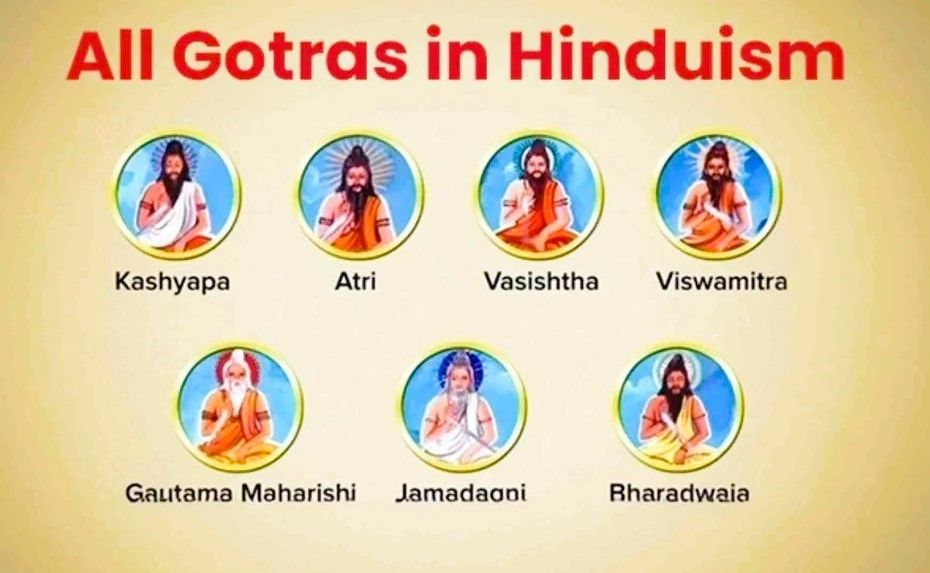
Several Gotras are Recognized across Hindu society, each linked to a sage or ancestral figure. Some of the common lineages include:
- Ayodya – Associated with the lineage of rulers and ancestors connected to the sacred city of Ayodhya.
- Agastya – Tracing descent from Sage Agastya, revered for his wisdom and contributions to Vedic literature.
- Basistha (Vasistha) – Linked to Sage Vasistha, one of the Sapta Rishis, known for his spiritual authority.
- Bharadwaja – Descendants of Sage Bharadwaja, celebrated for his knowledge of medicine and rituals.
- Chaudhrana and Chikara – Regional lineages reflecting local ancestral traditions.
- Dattatreya – Associated with the sage and deity Dattatreya, symbolizing divine wisdom.
- Dhananjaya – A lineage connected to heroic and warrior traditions.
- Gautamasa (Gautama) – Descendants of Sage Gautama, known for his contributions to dharma and philosophy.
- Guntur and Kirtan – Localized lineages tied to cultural practices and community identity.
- Harita – A lineage tracing back to Sage Harita, often invoked in rituals.
- Jamadagni – Descendants of Sage Jamadagni, father of Parashurama, one of Vishnu’s avatars.
- Jambhumaharishi – Connected to Kashyapa’s lineage, emphasizing continuity of Vedic ancestry.
- Kashyapa – One of the most prominent gotras, tracing descent from Sage Kashyapa, regarded as a progenitor of many clans.
- Katyayan – Linked to Sage Katyayana, known for his contributions to grammar and ritual practices.
- Lohithyasa and Madhukalya – Regional lineages reflecting diverse ancestral traditions.
- Markandeya – Descendants of Sage Markandeya, revered for his devotion and longevity.
- Narayana – A lineage symbolizing devotion to Lord Narayana (Vishnu).
- Raghupathi and Raghav – Connected to the lineage of Lord Rama and the Raghu dynasty.
- Panchal and Pipal – Regional clans tied to community identity.
- Sandilya – Descendants of Sage Sandilya, often invoked in marriage rituals.
- Tarkia and Upadhayay – Lineages reflecting scholarly and priestly traditions.
- Uttam – A clan emphasizing noble ancestry.
- Vishvamitra – Descendants of Sage Vishvamitra, one of the Sapta Rishis, known for his spiritual transformation.
- Yadav – A lineage connected to Lord Krishna and the Yadava clan.
Social and Cultural Role
Gotra plays a crucial role in Hindu society, particularly in marriage customs. The principle of exogamy marrying outside one’s gotra ensures diversity and prevents unions within the same lineage. This practice reinforces social harmony and strengthens bonds between different families.
Beyond marriage, gotra is invoked during rituals and ceremonies, where priests recite the family’s lineage to honor ancestral sages. It serves as a reminder of heritage, linking individuals to their spiritual forefathers and reinforcing cultural identity.
Conclusion
The Types of Gotras in Hinduism reflect the diversity and richness of ancestral traditions. From sages like Kashyapa, Bharadwaja, and Vishvamitra to regional lineages such as Chaudhrana and Guntur, each gotra carries unique significance. Together, they form a complex system that preserves genealogical identity, regulates social customs, and reinforces spiritual continuity. Even today, gotra remains a vital part of Hindu society, symbolizing the enduring bond between individuals, their ancestors, and the sacred heritage of Vedic tradition.