
Introduction
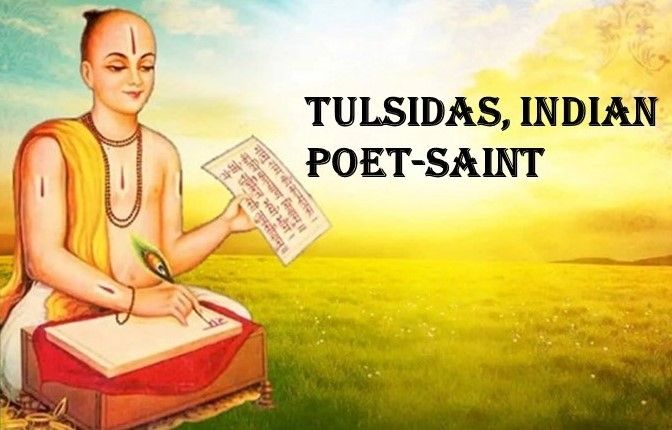
Tulsidas, one of India’s most revered poet-saints, began his literary journey in 1574. His writings, infused with deep devotion to Lord Rama, are celebrated as Masterpieces of Indian Literature. Among his many compositions, the Ramcharitmanasstands out as his magnum opus, a text that reshaped spiritual thought and became a cornerstone of Hindu devotion. Written in Awadhi, it brought the story of Rama to the common people, making profound philosophy accessible through simple yet powerful verses. Many of its lines have become proverbs, woven into everyday speech by millions of Hindi speakers.
Major Literary Works
Ramcharitmanas
The Ramcharitmanas is Tulsidas’s longest and most celebrated work. Its title means “The Holy Lake of the Acts of Lord Rama.” Inspired by Valmiki’s Ramayanaand other sources, Tulsidas crafted a devotional epic of around 12,800 lines divided into 1,073 stanzas. The text is structured into seven books or kandas: Bala Kanda, Ayodhya Kanda, Aranya Kanda, Kishkindha Kanda, Sundara Kanda, Lanka Kanda, and Uttara Kanda. Written in chaupai and doha metres, the epic blends poetry with philosophy, narrating Rama’s life as an ideal son, king, and divine incarnation. Its verses are recited daily in temples and homes, remaining central to Hindu rituals and festivals.
Vinaya Patrika
Composed in Braj Bhasa, the Vinaya Patrikacontains 279 stanzas. The first 43 are hymns dedicated to various deities and courtiers of Lord Rama, while the rest focus on Rama himself. This work is considered Tulsidas’s second greatest composition after the Ramcharitmanas, reflecting his humility and devotion.
Hanuman Chalisa
Perhaps the most widely recited of his works, the Hanuman Chalisa is a hymn of 40 chaupais and two dohasdedicated to Lord Hanuman. It is believed to have been composed during a state of spiritual ecstasy at the Kumbh Mela in Haridwar. Recited especially on Tuesdays and Saturdays, it remains a cornerstone of devotional practice in northern India.
Dohavali
The Dohavali is a collection of 573 dohas or couplets written in Braj and Awadhi. These verses cover themes of political wisdom, righteousness, and the purpose of life. Many of them are still quoted as moral lessons and are part of school curricula across India.
Kavitavali
This work consists of 325 verses composed in the Kavittafamily of metres. Like the Ramcharitmanas, it is divided into seven kandas. However, it is distinct in style, offering philosophical reflections and devotional poetry.
Gitavali
The Gitavali is a collection of 328 songs set to classical raagas. Divided into seven kandas, it combines music with devotion, making it a unique contribution to spiritual literature.
Krishnavali
Dedicated to Lord Krishna, the Krishnavalicontains 61 songs. Thirty-two describe Krishna’s childhood and rasalila, while others narrate dialogues with Uddhava and episodes like Draupadi’s disrobing.
Minor Works
Tulsidas also Composed shorter works such as Barvai Ramayana, Parvati Mangal, Janaki Mangal, Ramalala Nahachhu, Ramagya Prashna, and Vairagya Sandipini. Together, his literary output includes 22 works, reflecting his versatility and devotion. His writings were later translated into English by Binda Prasad Khattri, ensuring their reach beyond India.
Conclusion
The literary works of Tulsidas are not merely Poetry but spiritual treasures that Continue to nspire millions. His compositions, whether the grand Ramcharitmanas or the concise Hanuman Chalisa, embody devotion, wisdom, and humanity. By writing in the vernacular, he democratized spiritual knowledge, making it accessible to all. Tulsidas remains a timeless poet-saint whose words echo with love for Lord Rama and the values of righteousness and faith.