
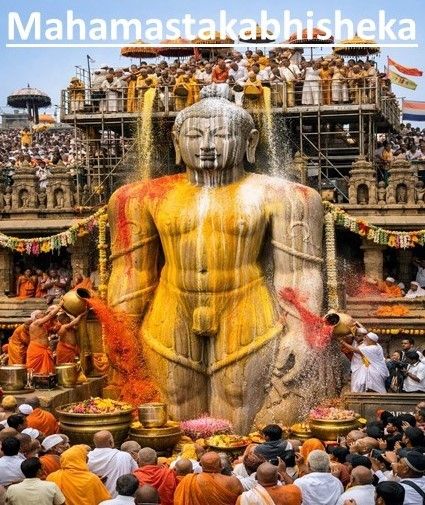
The Mahamastakabhisheka, often called the Grand Consecration or the Great Indian Festival, is one of the most sacred and awe-inspiring celebrations in Jainism. Observed once every twelve years, this magnificent ritual involves the ceremonial anointment (abhisheka) of Jain idols, with the most iconic being the colossal statue of Bahubali Gommateshwara at Shravanabelagola in Karnataka.
Observance of Mahamastakabhisheka
The festival’s timing is determined by the luni-solar Jain calendar, ensuring its occurrence every twelve years. The most recent consecration was held in February 2018 at Shravanabelagola, marking the 88th event since its inception in 981 AD. This was the second Mahamastakabhisheka of the 21st century, with the next scheduled for 2030.
The 2018 celebration, led by Charukeerthi Bhattaraka Swamiji, spanned from 17th to 25th February. It was inaugurated by President Ram Nath Kovind and concluded with Prime Minister Narendra Modi’s presence, underscoring its national importance. Thousands of Jain ascetics and devotees gathered, transforming Shravanabelagola into a vibrant spiritual hub.
Historical Background
Bahubali, son of Rishabhanatha, the first Tirthankara of Jainism, is revered for his renunciation and attainment of enlightenment. His story, preserved in texts like the Adi Purana and Bahubali Charitra, recounts his victory over his brother Bharata in a duel, followed by his deep remorse. Choosing meditation over worldly power, Bahubali attained Nirvana, becoming a symbol of detachment and spiritual triumph.
Centuries later, in 983 AD, the monumental statue of Bahubali was erected atop the Vindhyagiri Hills at Shravanabelagola. Standing 57 feet tall, it remains one of the largest free-standing monolithic statues in the world, embodying the ideals of Jain philosophy and spiritual liberation.
Celebration and Rituals
The Mahamastakabhisheka spans several days and is marked by elaborate rituals. At its commencement, devotees sprinkle holy water using 1,008 specially prepared vessels. The statue is then bathed with purified water, sandalwood paste, and anointed with libations such as milk, sugarcane juice, saffron, and powders of turmeric, vermilion, and sandalwood.
Offerings of flower petals, precious gems, and coins of gold and silver are made, symbolizing devotion and spiritual upliftment. These rituals are believed to purify the soul, aligning with Jain principles of non-attachment and inner awakening.
Bahubali’s legacy extends beyond Shravanabelagola, with statues at Karakala, Dharmasthala, Venur, and Kumbhoj, each honoring his virtues and spiritual ideals.
Spiritual Significance
The Mahamastakabhisheka is not merely a festival but a profound spiritual journey. For the Jain community, it embodies The Ideals of Renunciation, meditation, and liberation. The grandeur of the rituals reflects the collective devotion of millions, while the towering statue of Bahubali serves as a reminder of the eternal pursuit of enlightenment.
By participating in the consecration, devotees believe they gain spiritual merit, fostering inner purity and progress toward liberation. Bridging history, faith, and tradition, the Mahamastakabhisheka stands as one of India’s most awe-inspiring religious celebrations.