
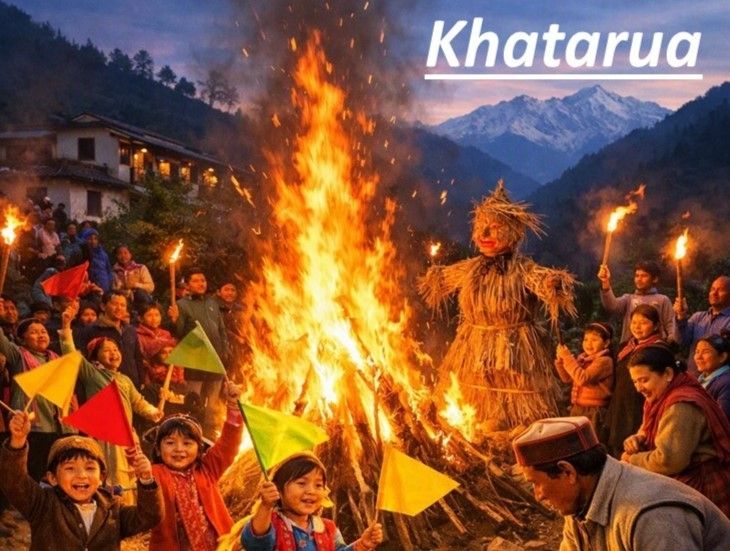
Khatarua is one of the most vibrant and deeply cherished festivals of Uttarakhand, celebrated with immense enthusiasm in the villages of the Kumaon region. Observed in mid-September, on the first day of the Hindu month of Ashwin, it marks the arrival of autumn and reflects the agrarian traditions of mountain society. Distinguished by bonfires, colourful flags, lively dances, and offerings, Khatarua Creates an Atmosphere of Warmth, unity, and celebration.
Origins and Legends
Khatarua is not merely a seasonal festival; it carries historical significance. According to legend, it commemorates the victory of King Baz Bahadur Chand of the Chand dynasty over the Garhwal forces. After King Rudra Chand’s death, Garhwal forces invaded Kumaon during succession disputes. Baz Bahadur Chand devised a clever strategy: he sent soldiers accompanied by cows and flags bearing cow symbols to storm Chandpur Garhi. Since cows were sacred to the Garhwalis, their army hesitated to attack, enabling the Kumaonis to secure victory.
This tale underscores the symbolic importance of cows in Khatarua. Following the battle, cucumbers were shared among soldiers as a humble feast, while bonfires were lit to signal victory to Almora, the capital. Even today, cucumbers and bonfires remain central to the festival’s rituals.
Celebration and Rituals
Khatarua is celebrated with great enthusiasm across Kumaoni villages. In the evening, heaps of firewood and grass are stacked to create large bonfires known as the “fire of Khatarua.” Effigies of Khatarua are erected and later set ablaze. Children wave colourful flags, sing folk songs, and dance around the flames, while elders join in the merriment.
Offerings of cucumbers are made to the fire, symbolizing the destruction of evil and negativity and the ushering in of prosperity and virtue. Animals, especially cattle, are given special care during the festival, fed with fresh grass, and blessed with torchlight rituals carried out by families. Torches are waved around cattle sheds and homes to ward off misfortune.
The bonfire becomes a focal point of community bonding, where villagers gather, laugh, sing, and celebrate the changing season. The joyous atmosphere reflects the agrarian society’s gratitude for harvests and hope for prosperity.
Cultural Significance
Khatarua is more than a seasonal festival; it is a cultural marker of Kumaon’s identity. It blends agricultural traditions with historical memory, Reinforcing Values of Unity, reverence for cattle, and the triumph of good over evil. Despite modern reinterpretations that downplay the Garhwal-Kumaon battle narrative, the festival continues to thrive as a cherished tradition.
The folk chant sung during Khatarua “Chal Khatarua dhaare dhaar; gau ki jeet, khature ke haar” encapsulates its essence: the victory of the cow, the defeat of evil, and the continuity of life and virtue across the hills.
Conclusion
Khatarua remains a festival of joy, resilience, and cultural pride in Uttarakhand. It celebrates not only the onset of autumn but also the spirit of community and the deep-rooted traditions of the Kumaoni people. With bonfires blazing, flags fluttering, and cucumbers offered to flames, Khatarua continues to illuminate the mountain villages with warmth, hope, and heritage.