
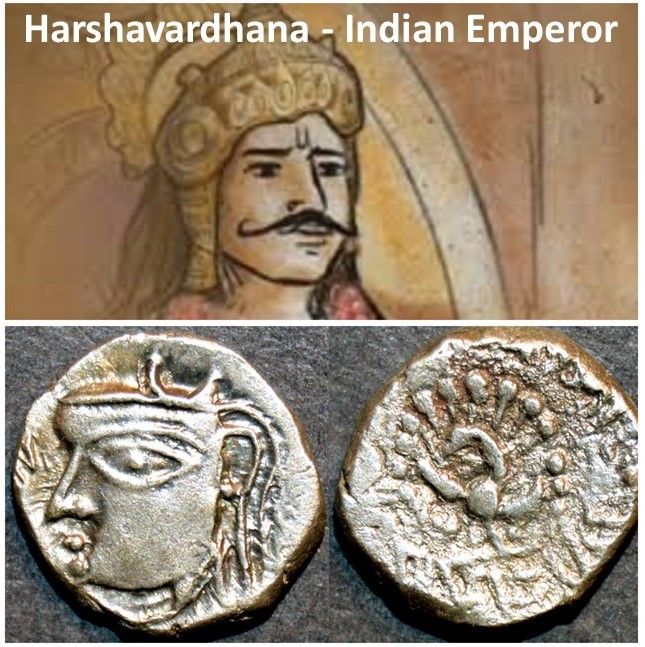
Introduction
Among the towering figures of early medieval India, Harshavardhana occupies a unique place as a ruler who bridged two distinct epochs. His reign in the 7th century marked the transition from the classical Gupta age to the fragmented medieval era, when regional powers vied for supremacy. Popularly known as Harsha, he belonged to the Pushyabhuti (or Vardhana) dynasty, which rose to prominence after the decline of the Guptas. His rule is remembered for military ambition, administrative efficiency, and remarkable patronage of religion and culture. Though his empire did not endure long after his death, Harsha’s legacy continues to symbolize tolerance, prosperity, and political vision.
Ascension of Harshavardhana
Harsha was born in 590 CE to King Prabhakaravardhana of Thanesar. His early life was marked by tragedy. After the death of his elder brother Rajyavardhana, who was killed in a conflict with the Malwa king, Harsha ascended the throne in 606 CE at the tender age of sixteen. Despite his youth, he quickly consolidated power, avenged his brother’s death, and began expanding his dominion across northern India. His rise was not only a personal triumph but also a turning point in the politics of the subcontinent, as he emerged as one of the last great emperors of northern India.
Religious Inclinations
Although Harsha was born into a Hindu family, Harsha Spiritual Journey led him toward Buddhism. Influenced by scholars and monks, most notably the Chinese pilgrim Xuanzang, who visited his court, Harsha embraced Buddhist ideals while remaining tolerant of all faiths. His reign is often described as a golden age of religious harmony. He supported Hindu temples, Buddhist monasteries, and encouraged philosophical debates. Under his rule, Shaivism, Vaishnavism, and Buddhism coexisted peacefully, reflecting his vision of inclusivity and spiritual pluralism. This religious tolerance became a hallmark of his reign and a defining feature of his legacy.
The Reign of Harshavardhana
Harsha ruled for more than four decades, establishing his capital at Kannauj, which became a prominent political and cultural hub. His empire stretched from Punjab in the west to Bengal in the east, and from the Himalayas in the north to the Narmada River in the south. He maintained diplomatic relations with foreign powers, including China, and organized grand religious assemblies where scholars debated diverse philosophies. His reign was characterized by stability, prosperity, and cultural flourishing, making him one of the last great emperors before the rise of regional kingdoms.
Social Conditions During His Rule
Society under Harsha was hierarchical, with kings, nobles, priests, and merchants occupying prominent positions. Agriculture formed the backbone of the economy, while trade flourished both internally and externally. Xuanzang’s accounts describe the people as honest, simple, and law-abiding. Education was widespread, with Nalanda University thriving under Harsha’s patronage. Literature, art, and architecture also flourished, reflecting the intellectual vibrancy of the age. The cultural life of his empire was enriched by Sanskrit poetry, Buddhist texts, and architectural innovations, which together created a vibrant atmosphere of learning and creativity.
Administration of Harshavardhana
Central Authority
Harsha was the supreme authority but delegated responsibilities to trusted officers. His administration was well-organized and efficient, ensuring stability across his vast empire.
Key Officials
- Kumaramatya – senior officials assisting the king
- Mahasandhivigradhikrita – minister of war and peace
- Mahabaladhikrita – officer in supreme command
- Baladhikri – commander of the army
- Brihadavavara – head cavalry officer
- Katuka – commandant of the elephant force
- Pathi – superintendent of soldiers’ barracks
- Duta – ambassador
- Rajasthaniya – foreign secretary
Army and Police
Harsha maintained a strong army with infantry, cavalry, and elephants. His military strength allowed him to expand and defend his empire. The police department included officers such as Dandapashika and Dandika, while a sophisticated spy system monitored officials and detected crimes.
Provincial and Village Administration
The empire was divided into provinces governed by officials who reported to the king. Local administration was decentralized, allowing villages to manage agriculture, irrigation, and disputes. Village councils played a crucial role in grassroots governance.
Crime, Punishment, and Revenue
Punishments were strict but fair, ranging from fines to imprisonment. The justice system emphasized deterrence and order. The main sources of income included:
1. Udranga – land revenue
2. Uparikara – additional taxes and fines
3. Hirenya – payments in gold
4. Ordinances – special levies
Military Campaigns and Conquests
Expansion in the East
Harsha extended his influence into Bengal and Bihar, consolidating his power in eastern India. By subduing Bengal, he strengthened his eastern frontier and secured valuable resources.
Campaigns in the West and Sindh
He fought against the rulers of Vallabhi in Gujarat, eventually establishing friendly relations through matrimonial alliances. His forces also marched into Sindh, bringing the region under his control.
Northern Campaigns
Harsha extended his authority into Kashmir and maintained relations with Nepal, showcasing his northern expansion. He also brought Odisha under his control, further consolidating his eastern territories.
Conflict with the Chalukyas
Harsha’s most significant conflict was with Pulakeshin II of the Chalukya dynasty. In the famous battle near the Narmada River, Harsha was defeated, marking the southern boundary of his empire. Despite his military brilliance, this defeat prevented him from extending his dominion into southern India. Nevertheless, he exerted influence over parts of the Deccan through diplomacy.
Expansion and Limitations
Harsha’s empire was vast, covering most of northern India. His expansion was achieved through both military campaigns and diplomatic alliances. However, his defeat against the Chalukyas limited his southern ambitions. By conquering Bengal and Bihar, Harsha secured the rich resources of eastern India, strengthening his empire economically and strategically. His reign thus combined both triumphs and constraints, reflecting the challenges of ruling a diverse subcontinent.
Conclusion
Harshavardhana was a remarkable emperor whose reign bridged the ancient and medieval phases of Indian history. His administration was efficient, his patronage of religion and culture was generous, and his military campaigns shaped the political landscape of 7th-century India. Though his empire did not survive long after his death in 647 CE, Harsha’s legacy endures as a symbol of tolerance, cultural prosperity, and political ambition. His reign remains A Shining Chapter in the History of India, reflecting the complexities of power, faith, and governance during a transformative era.